


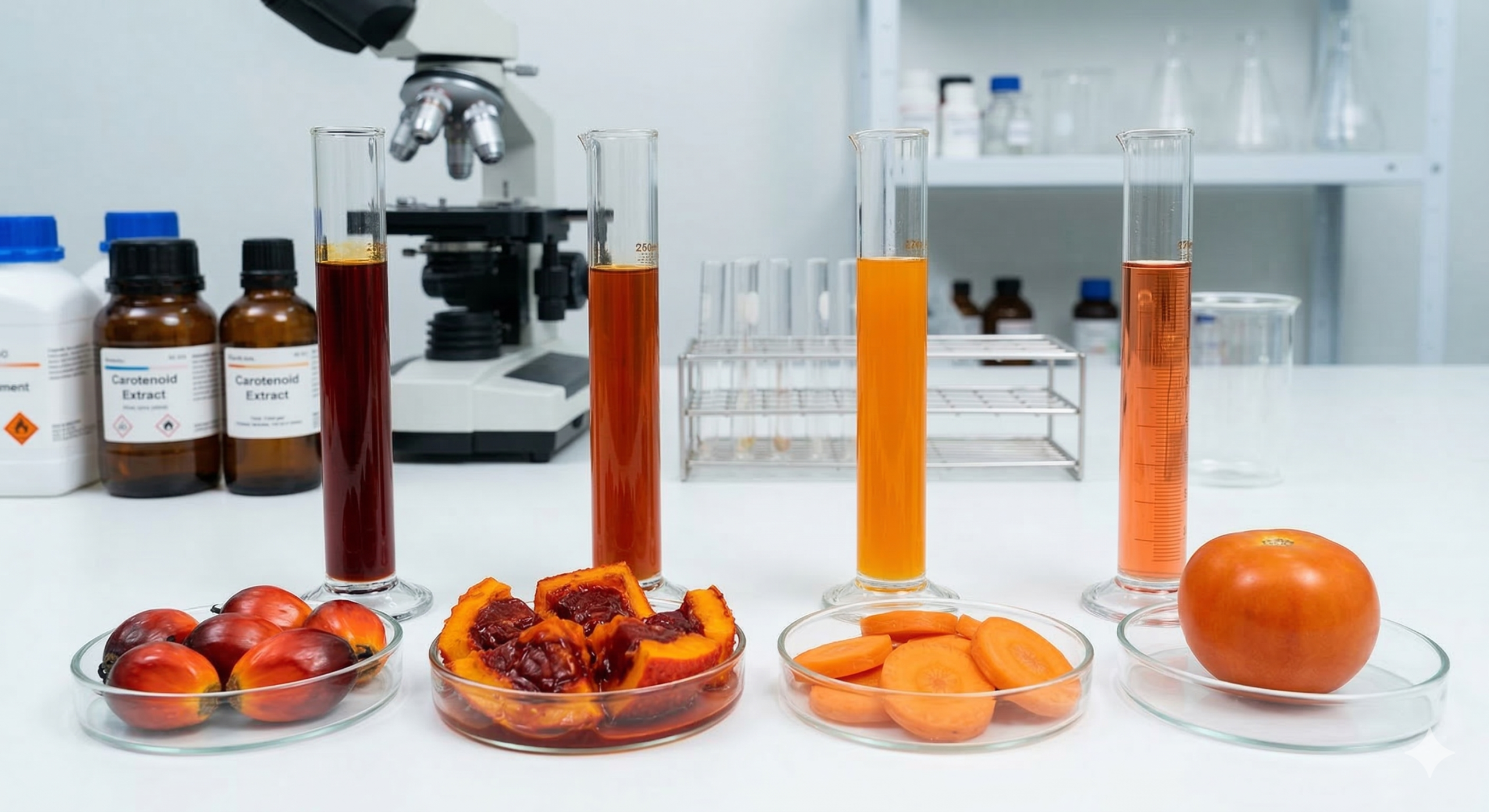
In our collective memory, the vibrant orange colour of food is almost always synonymous with one name: the carrot. Since our primary school days, we have been taught that the carrot is the gold standard for eye health and Vitamin A intake. While this notion is not incorrect, a deeper dive into global nutritional data reveals a fascinating fact. Beyond the dominance of the carrot narrative, there lies a native tropical fruit that harbours a far more potent and extraordinary concentration of Vitamin A: the oil palm fruit. Through a clearer understanding of figures and data, we can see how nature has provided a liquid “nutrition factory” ready to support the nation’s health.
It is vital to understand that what we refer to as Vitamin A in plants actually appears in the form of carotenoids or Pro-Vitamin A. The human body is an intelligent biological machine; it converts these carotenoids into active Vitamin A according to metabolic needs. This is where the uniqueness of the oil palm fruit lies. In its natural state, the oil pressed from the fruit’s pulp (Palm Mesocarp Oil) possesses a deep, crimson-orange hue—a visual indicator that it is teeming with abundant carotenoid compounds.
Palm vs Carrots and Global Fruits
According to technical reports from the FAO (Food and Agriculture Organization) in the document Edible Fats and Oils, crude red palm oil contains total carotenoids ranging from 500 to 700 ppm (parts per million), with figures reaching even higher in certain varieties. To provide a clear perspective, a study published in the Journal of Food Science and Technology reveals that the Pro-Vitamin A content in red palm oil is recorded at 15 times higher than that of carrots and even 300 times higher than that of tomatoes.
However, for the sake of scientific objectivity, we must also view the global nutritional map as a whole. If the question arises: which fruit possesses the highest concentration of Pro-Vitamin A on earth? Specifically, that title is held by the Gac fruit (Momordica cochinchinensis), widely found in mainland Southeast Asia. Referring to research in the Journal of Food Composition and Analysis, the Gac fruit contains extreme levels of beta-carotene, reaching up to 20 times higher than that of carrots.
Despite the Gac fruit holding the record for pure concentration, it faces significant limitations in terms of mass cultivation and global accessibility. This is where palm oil emerges as the true champion for public health. Palm oil combines two strengths: a very high nutrient concentration (15 times that of carrots) and vast production scalability. This is reaffirmed in various health literatures, including The American Journal of Clinical Nutrition, which highlights that palm oil is the most efficient and realistic nutritional source for large-scale public health interventions, particularly in developing nations.
Securing Nutritional Sovereignty Through Superior Bio-availability
Understanding high vitamin levels is only one side of the story. The other equally important side is how well those vitamins can be absorbed by the human body. In the Journal of Nutrition Reviews, the concept of bio-availability is frequently discussed—a measure of how much of a nutrient actually enters our bloodstream. This is where palm oil’s absolute advantage appears. Vitamin A is fat-soluble. When we consume carrots, the body requires additional external fat intake for the beta-carotene to be optimally absorbed.
Red Palm Oil (PMO) offers a “ready-to-use” advantage. Because the Pro-Vitamin A within it is already encased in its natural fat matrix, the absorption process by the body is far more effective and instantaneous. This practical advantage makes red palm oil a perfect nutrient delivery system from nature. However, this great potential faces a real threat from conventional industrial processing methods. High-heat refining processes aimed at “clearing” the oil are the primary cause of the loss of this crimson treasure. Therefore, low-temperature processing and gentler methods have become an absolute necessity.
Agro Investama Group, through SPOT (Steamless Palm Oil Technology), is here to address this challenge. Based on technical studies aligned with the vision of BPDPKS, we recognise that maintaining the red colour of the oil is not merely about aesthetics, but about preserving nutritional integrity. By eliminating the use of extreme steam heat and high-temperature bleaching, SPOT technology ensures that the carotenoids—which are 15 times more abundant than in carrots—remain intact. Through the PAMER modular units, we bring this technology directly to the plantations to lock in the vitamin content at its freshest state.
Ultimately, this data invites us to review our nutritional priorities. Indonesia, as the world’s largest palm oil producer, has a massive opportunity to lead global health solutions. With the right technology, we can ensure that palm oil is not merely an industrial commodity, but a primary nutritional source that ensures every child of the nation grows up with a resilient and healthy body. It is time we begin to appreciate palm oil as the most precious nutritional essence from our own soil.
Tags: Palm Fruit, Vitamin A







 Facebook
 Instagram
 Tiktok
 Linkedin